
Article: A Little Too Close to the Work

A Little Too Close to the Work

A Little Too
Close to the Work
I've been thinking lately about how much time I spend making things, and how little time I spend talking about them.
It's a strange thing.
I can spend months developing a fabric, revisiting a pattern, adjusting a seam by a fraction of an inch, or experimenting with a wash until it finally feels right.
And then, when it's finished, I move on to the next thing.
I've never been particularly good at marketing. I look at our social media, the photographs, the stories we haven't told, and sometimes wonder if I'm doing any of this justice.
I've spent more than twenty years learning how to make clothes. I wish I could say I'd spent as much time learning how to tell people about them.
Perhaps I'm just a little too close to the work.
There are stories behind nearly everything we make. Some are about the cloth, some about the process, and others about ideas that probably shouldn't have worked in the first place.
Rivera is one of those stories.
THE MAKING OF RIVERA
It was around 2011. I'd just returned from a surf trip, and I remember feeling particularly hungry to create something.
At the time, I was thinking a lot about denim. Not necessarily the fabric itself, but the rules surrounding it.
The five-pocket jean. The waistband. The yoke. The coin pocket. The traditional front pockets. All these elements that had become so familiar that nobody really questioned why they were there anymore.
I had another pant in the collection called Coronel. A slash-pocket, button-fly pant that still lived comfortably within the traditional vocabulary of denim.

had rules.
THE LANGUAGE OF DENIM
AND THE RULES AROUND IT
I remember someone telling me the pockets didn't work together. The front pockets were happy, the back pockets were sad. Apparently, even pockets had rules.
And avant-garde fashion wasn't much different.
Somewhere along the way, it seemed that the more pattern pieces you used, the more avant-garde something became. And apparently, everything had to be black.
Why?
I wasn't interested in making something complicated simply for the sake of being complicated.
I wanted to make the antithesis of the conventional five-pocket jean.
What was the least amount of pattern work required to make a truly utilitarian pant?
Not somebody else's idea of utility.
Mine.
I remember taking a piece of chalk to the pants I was wearing, marking where I wanted the front pockets to fall.
No waistband. No coin pocket. No back yoke. No buttonholes. No traditional front pocket scoops.
The back pockets would sit low.
The inseam would be 29 inches because that's where I wanted my pants to fall, just above my ankles.
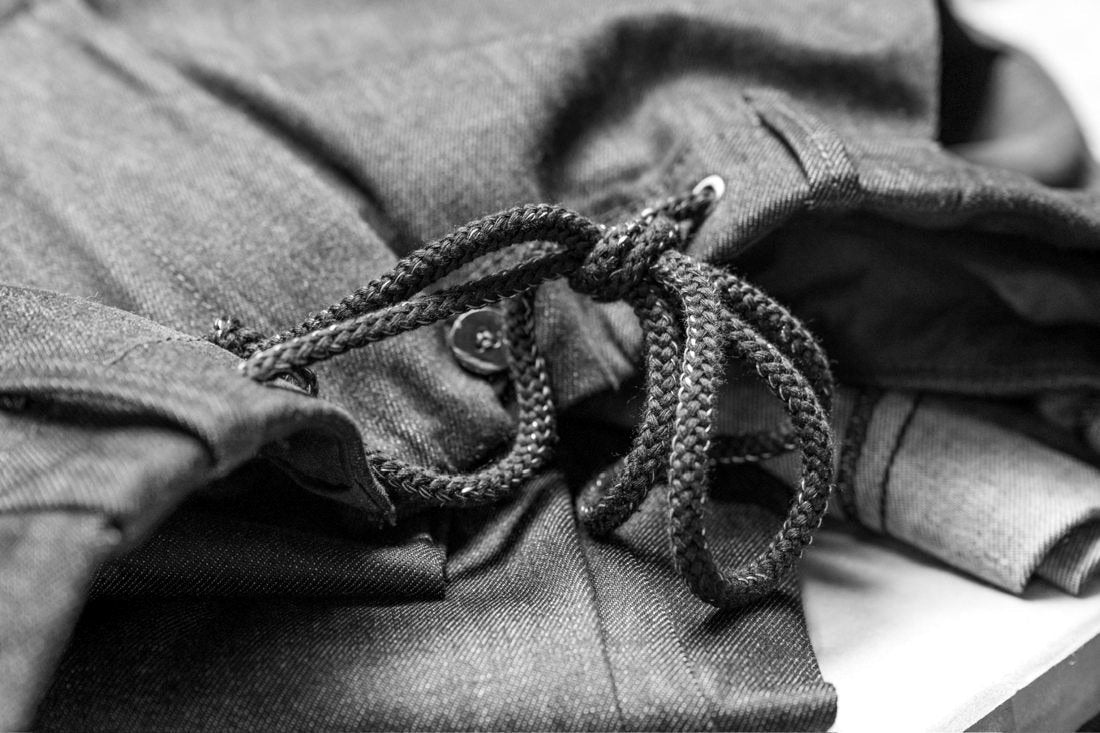
And, of course, a drawcord.
Because fuck your rules.
I was still making my own samples then, working through ideas directly in cloth. Making decisions on the fly, correcting things as I went.

It was perfect.
At least to me.
The first Rivera looked remarkably similar to the one we make today. I may have made a second prototype, but most of the decisions had already been worked out with my own hands.
I began connecting the front and back panels, eliminating conventional seams and allowing the remaining construction to do more of the work.
I wanted one of those seams to cross the thigh and move toward the top of the knee. Almost like a hinge, where two different grain directions meet and the fabric might respond differently to movement.
There was very little visible topstitching. No traditional double-needle detailing. Much of the construction was hidden inside the garment, with French seams and a deliberately quiet approach.
The result was oddly shaped. Unfamiliar.
It was my favorite pant.
The problem was convincing anyone else.
Buyers gravitated toward things they understood. Familiar silhouettes, familiar construction, familiar details. The five-pocket jean had been refined for more than a century, and I respect that history.
But I couldn't understand why we were still expected to follow the same rules. Why denim had to be a five-pocket jean. Why a pant made from denim had to reference workwear from a bygone era.

Rivera didn't offer much of that familiarity.
I was told you couldn't sell pants with a 29-inch inseam. The alpha sizing was a problem. The silhouette was too unconventional.
But I kept making it.
Season after season.
Not because it was selling particularly well, but because I loved wearing it. I believed in it. I could see its potential.
Eventually, a few retailers took a chance. Their customers were curious. People started trying them on, and slowly, the conversation changed.
It wasn't an overnight success.
It was persistence.
Today, Rivera has become one of our most sought-after silhouettes. We've made it in lightweight cloth, heavy denim, stretch fabrics, rigid fabrics, and finishes I couldn't have imagined when I first drew those chalk marks.

Men wear it. Women wear it. People wear it in ways I never intended.
Much of the collection now revolves around ideas that first took shape in Rivera. The single-panel construction, the stripped-down details, the simplicity. Removing anything unnecessary, anything that might distract from the garment itself.
Years ago, a buyer who had spent a long time navigating the menswear industry gave me some advice.
She told me:
"You're not a denim designer. You're a fucking designer. And a good one. Make ten pieces every season that you want to wear."
I've carried that with me ever since.
It's harder advice to follow than it sounds.
There's always noise. What retailers want. What the market is doing. What's selling. What's not. What other designers are making. What we're supposed to be doing next.
And somewhere in all of that, you have to remember why you started.
Rivera reminds me.
It's not a pant I designed because the market needed another pair of pants.
It's a pant I made because I wanted it to exist.
Fifteen years later, we're still making it.
And I still wear it.
I suppose that's the story I should have been telling all along.

Thanks for reading.
Matias
MATiAS
Los Angeles

Written by Matthew Sandoval